
The Case for Client-Side Compute: Leveraging CPU/GPU for Instant React Apps and Next-Gen Performance

By ReactBooster
10 mins read

You've done all the "best practices." Your React app uses code splitting, memoization, virtualization, and even sophisticated Server-Side Rendering (SSR) or Static Site Generation (SSG). Yet, despite hitting impressive Lighthouse scores in development, your Real User Monitoring (RUM) data (and Google Search Console) tells a different story: users on mid-range mobile devices are still experiencing frustrating delays, janky interactions, and ultimately, high bounce rates.

Why does performance remain elusive even after aggressive optimization? The answer is simple: the bottleneck has shifted. It's no longer just the network; it's the single-threaded CPU on the client side, and it's time to leverage the entire device.

Welcome to the era of Client-Side Compute – a paradigm shift that will redefine what "instant" truly means for your React applications.

The React Performance Plateau: Why Traditional Methods Fail

For years, web performance optimization focused heavily on the network. We optimized images, minified assets, implemented CDNs, and embraced HTTP/2. These efforts paid off, drastically reducing initial load times. However, as applications grew more complex, especially with frameworks like React, the bottleneck moved.

Today, the primary struggle is the CPU Bottleneck on the client's device. JavaScript execution, React hydration, complex state updates, and intricate UI logic all demand processing power, and they all run on the browser's single main thread. When this thread is busy, the UI freezes, user interactions are delayed, and the perception of speed evaporates.

The Bottleneck Shift. Performance issues have moved from the network to the client. Modern apps are no longer slowed by connection speed, but by the single-threaded CPU bottleneck.

This isn't just an annoyance; it directly impacts crucial metrics like:

  • Interaction to Next Paint (INP): The time from a user interaction (click, tap) to the next visual update. A blocked main thread means high INP, a direct hit to user experience, and a new Core Web Vitals.
  • Largest Contentful Paint (LCP): The time it takes for the largest content element to become visible. If the CPU is busy parsing and executing JavaScript, it delays painting, leading to a slow LCP.

These issues are dramatically amplified on devices with less powerful processors – which, statistically, represent the vast majority of the global mobile market. Your flagship users might be fine, but everyone else is struggling.

Why We Must Look Beyond the Main Thread

The irony of the CPU bottleneck is that most modern devices are packed with untapped power.
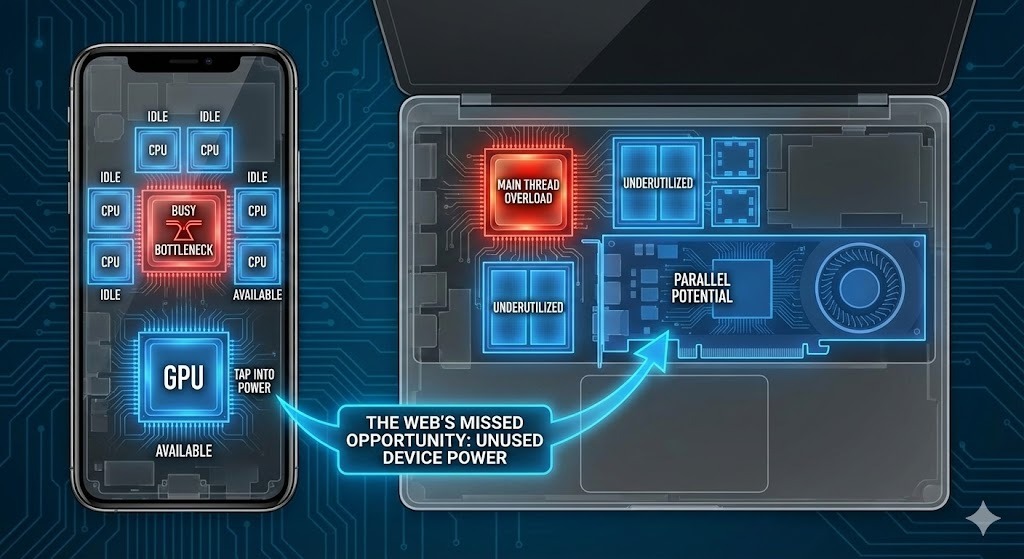
Wasted Potential. While your app struggles on a blocked main thread, vast computing resources, including multi-core CPUs and the GPU, sit idle on the user's device.

Modern smartphones, tablets, and laptops come equipped with:

  • Multi-core CPUs: Even mid-range phones have 4, 6, or 8 CPU cores.
  • Powerful GPUs: Originally for graphics, GPUs are excellent at parallel processing for general-purpose computing (GPGPU).

Yet, your single-threaded JavaScript application is only using a tiny fraction of this available horsepower. It's like having an eight-lane highway but only driving in one lane while the others sit empty. This inefficiency is a major missed opportunity for truly instant experiences.

This is where Client-Side Compute steps in. It's the strategy of intelligently moving complex, non-UI-blocking tasks, such as large data transformations, heavy numerical computations, sophisticated animations, or even parts of your React rendering process, off the single main thread and onto these underutilized multi-core CPUs and GPUs. The goal is to free up the main thread to focus purely on responsiveness, ensuring a buttery-smooth UI.

Adaptive Execution: The Engine of Client-Side Compute

Implementing manual client-side compute is a monumental engineering hurdle. While Web Workers allow for parallel execution, they introduce massive overhead: complex data serialization, state synchronization challenges, and the need for a total architectural refactor. Leveraging the GPU is even more specialized, requiring deep expertise in WebGL or WebGPU.

This is where Adaptive Execution becomes indispensable. It is the core intelligence of ReactBooster, acting as a transparent runtime layer that bridges the gap between sophisticated code and limited hardware.

How Hardware-Aware Orchestration Works

ReactBooster doesn't just run your code; it navigates the user's hardware. By detecting real-time device context (CPU, GPU, NPU), it delivers a custom-optimized execution path to ensure elite performance for every visitor.

Graphic illustrating different device types on parallel digital lanes highlighting unified app code, device performance database, local AI intelligence, and premium features for flagship devices.

ReactBooster detects real-time device context (CPU, GPU, Network) to deliver a custom-optimized path, ensuring green Core Web Vitals for every user.

1. Real-Time Context Detection

Backed by our Devices Performance Database, ReactBooster instantly profiles the user's specific hardware. It identifies available CPU cores, GPU memory, and specialized AI accelerators (NPUs) within milliseconds of the initial load.

2. Intelligent Task Distribution

ReactBooster identifies the heavy-lifting parts of your application, complex data filtering, Web AI models, or cinematic UI effects, and offloads them to the most efficient computing unit. By shifting logic from the Main Thread to Web Workers or the GPU, we ensure that your UI never "stutters," regardless of the background workload. This happens with minimal or no code refactoring on your part.

3. Guaranteed Performance Benchmarks

By preventing Main Thread congestion, ReactBooster transforms the "Poor" and "Needs Improvement" Core Web Vitals into a uniform "Good" category across your entire user base:

  • Sub-0.8s Speed Index: Content paints faster as the main thread is freed from the weight of initialization scripts.
  • Sub-50ms INP: User interactions (clicks, taps, scrolls) remain instant and responsive.
  • True UX Parity: Offer "Premium" experience to flagship devices while maintaining a high-fidelity, fluid experience that feels natively optimized for others.

The Business Imperative: Faster, Smarter, More Profitable

Embracing client-side compute through dynamic orchestration isn't just a technical achievement; it's a strategic business advantage:

  • Elevated SEO & Ranking: Consistent "Good" Core Web Vitals across your user base (as measured by RUM and CrUX) directly translates to higher search engine rankings and lower customer acquisition costs.
  • Increased Conversion Rates: Faster, more responsive applications lead to happier users, fewer bounces, and a significant boost in conversions and revenue.
  • Accelerated Developer Velocity: Free your engineering teams from the endless, time-consuming cycle of micro-optimizations. With ReactBooster handling the heavy lifting of performance, developers can focus on building innovative features and delivering business value faster.
  • Future-Proof Architecture: Client-side compute is not a temporary fix; it's the next evolution of web architecture, designed to scale with ever-increasing application complexity and user expectations.

The Future is Distributed

The performance bottleneck has undeniably moved from the network to the client-side CPU. Trying to solve 21st-century performance challenges with 20th-century single-threaded approaches is a losing battle.

The future of web performance isn't about simply making code smaller; it's about making execution smarter. By harnessing the full power of modern devices through intelligent client-side compute and dynamic orchestration, React applications can finally deliver on the promise of instant, flawless experiences for every single user, everywhere.

Ready to unlock your app's full potential and lead the next wave of web performance? Discover how ReactBooster is revolutionizing your webapp speed.

Discover our newest articles

Mar 10, 2026
Digital abstract background with glowing data streams, binary code, and programming text fading into the distance.

Why Real User Monitoring (RUM) CWV Data is the Only Metric That Matters for SEO

READ MORE
Mar 4, 2026
Close-up of a black microchip mounted on a blue circuit board with glowing electronic pathways.

Leveraging CPU/GPU for Instant React Apps and Next-Gen Performance

READ MORE
Feb 20, 2026
Rocket with a glowing dollar sign launching amid floating digital dollar symbols and stock market graphs.

Why Core Web Vitals are the New Growth Engine

READ MORE

Don’t Let Slow Performance Hurt Your Business.
Become a Design Partner.

The orchestration engine is ready. Now, we are working with industry leaders to modelize high-impact tasks—from AI models, CRM data processing, complex rendering, to Pro-Creative workflows. Join us to define how your application logic should breathe across the hardware spectrum.